

Connecting solar panels, a battery, and the utility grid to the same inverter is only the starting point for an On Off Grid Hybrid Solar Inverter. What actually determines how well that inverter performs is what happens in the moment the grid drops out or comes back, since that transition has to happen fast enough that connected loads never notice the change.
When utility power fails, an On Off Grid Hybrid Solar Inverter has to detect the outage and switch to battery power within a window short enough that sensitive electronics, like a computer or a refrigerator's control board, do not reset or trip during the gap. A transfer time in the tens of milliseconds keeps that switch effectively invisible to connected equipment, while a slower transfer can cause exactly the kind of flicker or reset that undermines the entire point of having backup power to begin with. Getting transfer time this tight depends on how quickly the inverter's control circuitry can sense grid loss and command the switch, which is a function of the detection algorithm as much as the physical switching hardware itself. Testing this transition under a real load, rather than on a bench with nothing connected, is what exposes whether the switch is genuinely fast enough or only fast on paper.
Utility safety codes require a grid-connected inverter to stop feeding power back into the grid during an outage, protecting utility workers who may be repairing lines they assume are dead. An On Off Grid Hybrid Solar Inverter has to satisfy that anti-islanding requirement on the grid-tied side while still switching cleanly to off-grid operation on the load side, and those two behaviors have to be coordinated rather than treated as separate features bolted onto the same unit. Getting this sequencing right, disconnecting from the grid safely while simultaneously picking up the load from battery power, is where a well-engineered hybrid design separates itself from a simpler inverter that handles each mode independently without coordinating between them. Development work here focuses on making sure the anti-islanding check itself never becomes the bottleneck that slows the whole transfer down.
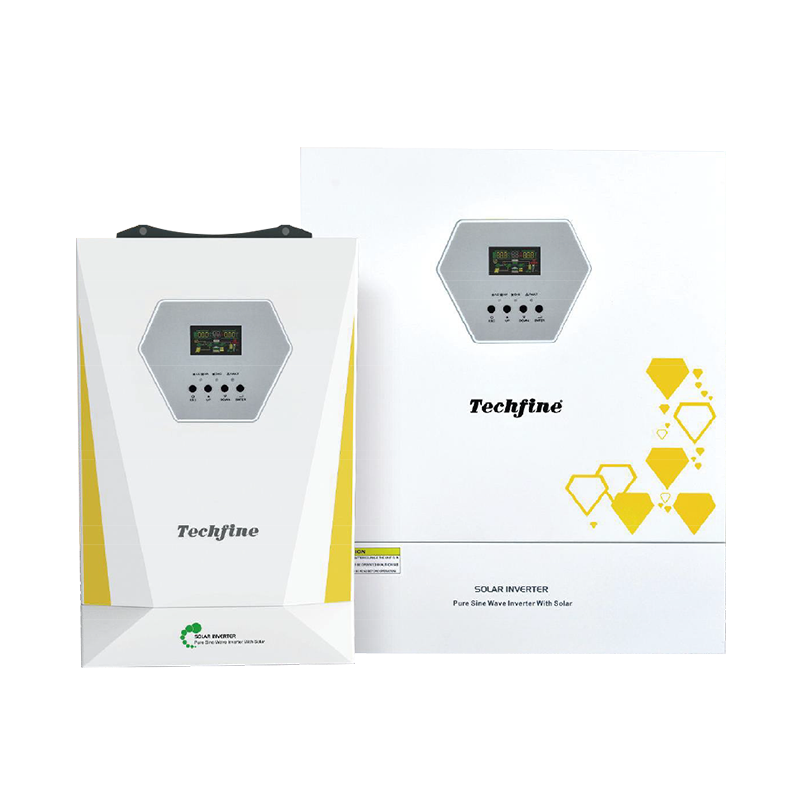
On a sunny day when solar production exceeds what the connected loads are drawing, an On Off Grid Hybrid Solar Inverter has to decide where the surplus goes: into the battery, out to the grid, or held in reserve depending on how the system is configured. Firmware handling this decision needs to weigh several inputs at once rather than following one fixed rule, since battery state of charge, time of day, and grid export limits can each point toward a different priority at a given moment. That routing logic runs continuously, adjusting in real time as cloud cover, load demand, and battery state of charge all shift throughout the day. A system configured to prioritize battery charging before grid export behaves very differently from one set up the other way around, and getting that priority logic right against a customer's actual usage pattern on an On Off Grid Hybrid Solar Inverter is as much a configuration question during installation as it is a hardware capability built into the inverter itself.
Transfer speed, anti-islanding coordination, and charge priority logic all work together on an On Off Grid Hybrid Solar Inverter, and a weakness in any one of the three shows up as a real, noticeable problem the moment the grid actually goes down rather than during normal day-to-day operation when all three modes rarely get tested at once.
Your email address will not be published. Required field are marked*


Call support 24/7 (Whatsapp)
+86 15988592807
Send us Email
[email protected]
Visit our location
Building 1, No. 21 Shengfa Road, Lucheng District, Wenzhou, Zhejiang, China



 中文简体
中文简体  Français
  عربى
عربى 