

A Dual-Sided Double-Glazed Photovoltaic Module collects light on both faces and keeps its cells sealed between two sheets of glass, and Wenzhou Sairifo New Energy Technology Co., Ltd. in Lucheng District, Wenzhou, Zhejiang, builds the SIF66D45 LB N-type version of that design. The two features solve different problems. Rear-side collection raises the energy a module delivers from a given footprint, while the glass-on-glass build protects the cells through the years of sun, rain, and temperature swings that follow installation.
A conventional module is laminated with glass on the front and a polymer backsheet on the rear. Over a decade outdoors, a backsheet can yellow, crack, or let moisture creep toward the cells. A double-glazed design replaces it with a second glass sheet. Glass is nearly impermeable to water vapor and does not age the way polymer does, so the cells stay sealed from both sides. A Dual-Sided Double-Glazed Photovoltaic Module from Wenzhou Sairifo New Energy Technology Co., Ltd. uses this construction, and the glass pair also makes the laminate stiffer, which limits cell microcracks under wind and snow load. Glass thickness and frame details for the SIF66D45 LB can be confirmed with the factory before ordering.
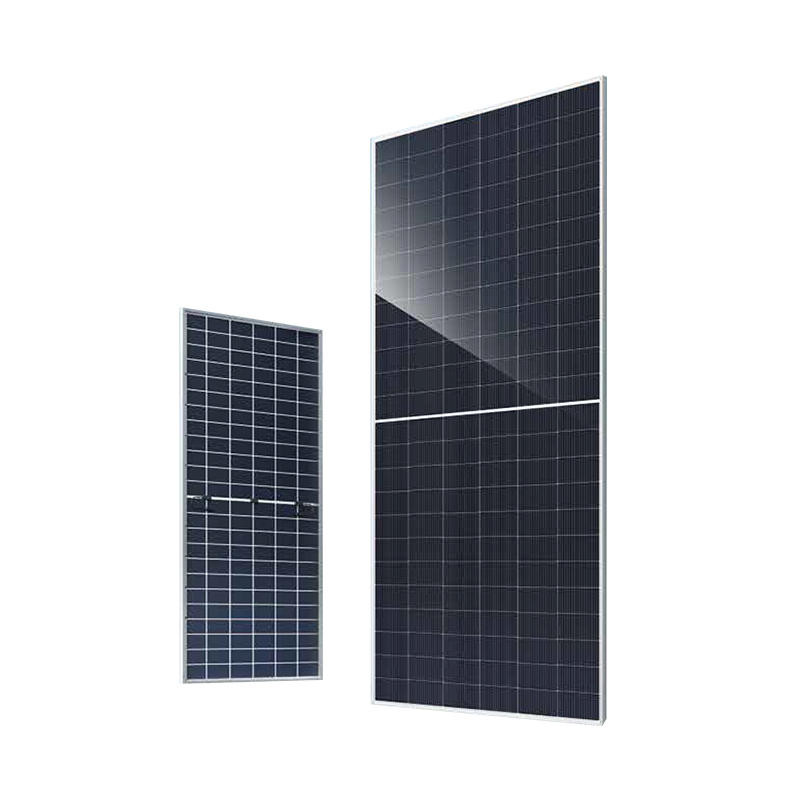
The rear face captures light reflected from the ground and scattered from the sky. The extra output, known as bifacial gain, depends heavily on what lies beneath the array. White roofing membrane, light gravel, sand, and snow reflect strongly, while dark asphalt returns much less. Mounting height, tilt, and row spacing also change how much light reaches the back. A Dual-Sided Double-Glazed Photovoltaic Module therefore performs differently from site to site, and the gain figure for a specific project can be confirmed with the factory before ordering.
The SIF66D45 LB uses N-type silicon cells. N-type wafers avoid the boron-oxygen defect behind the light-induced degradation seen in many P-type cells, so output loss in the early months is typically lower. N-type cells also tend to have a high rear-to-front efficiency ratio, which suits a dual-sided layout because the back face contributes real bifacial gain instead of a token amount. Wenzhou Sairifo New Energy Technology Co., Ltd. pairs these cells with the glass-glass laminate in each Dual-Sided Double-Glazed Photovoltaic Module. Power rating, efficiency, and temperature coefficient are not specified for this model here and can be confirmed with the factory before ordering.
Residential roofs have limited area, so energy per square meter matters. Rear-side collection adds output on light-colored roofs and on ground mounts above bright surfaces, and the sealed laminate suits systems expected to run for many years without attention. A Dual-Sided Double-Glazed Photovoltaic Module on a home roof keeps producing from both faces through many seasons.
Solar charging stations stand in open lots and roadsides, where dust, rain, and heat cycles are constant. Drone and unmanned ship power supply systems add humidity, salt air, and vibration. A glass-sealed module keeps moisture away from the cells in those conditions, and a stiff laminate handles movement better than a thin polymer-backed panel. Military power supply systems work in remote, exposed locations where replacement is slow, so durability carries extra weight. A Dual-Sided Double-Glazed Photovoltaic Module suits each of these uses, because sealing, stiffness, and rear-side output all help in exposed locations. Dimensions and weight for mobile or marine installations can be confirmed with the factory before ordering.
Utility-scale arrays paired with batteries put thousands of modules in one field, so small differences add up. Low degradation keeps annual output close to the design figure, and bifacial gain raises energy per hectare of land, which lowers the cost of each delivered kilowatt-hour. A Dual-Sided Double-Glazed Photovoltaic Module supports both goals on the same rack. Row spacing in such a field is planned around the light reaching the rear, and a Dual-Sided Double-Glazed Photovoltaic Module rewards that planning with more output from each rack. Where a site has pale gravel or snow cover, a Dual-Sided Double-Glazed Photovoltaic Module collects the extra reflected light that a single-sided module would miss.
Your email address will not be published. Required field are marked*


Call support 24/7 (Whatsapp)
+86 15988592807
Send us Email
[email protected]
Visit our location
Building 1, No. 21 Shengfa Road, Lucheng District, Wenzhou, Zhejiang, China


 中文简体
 Français
 عربى
